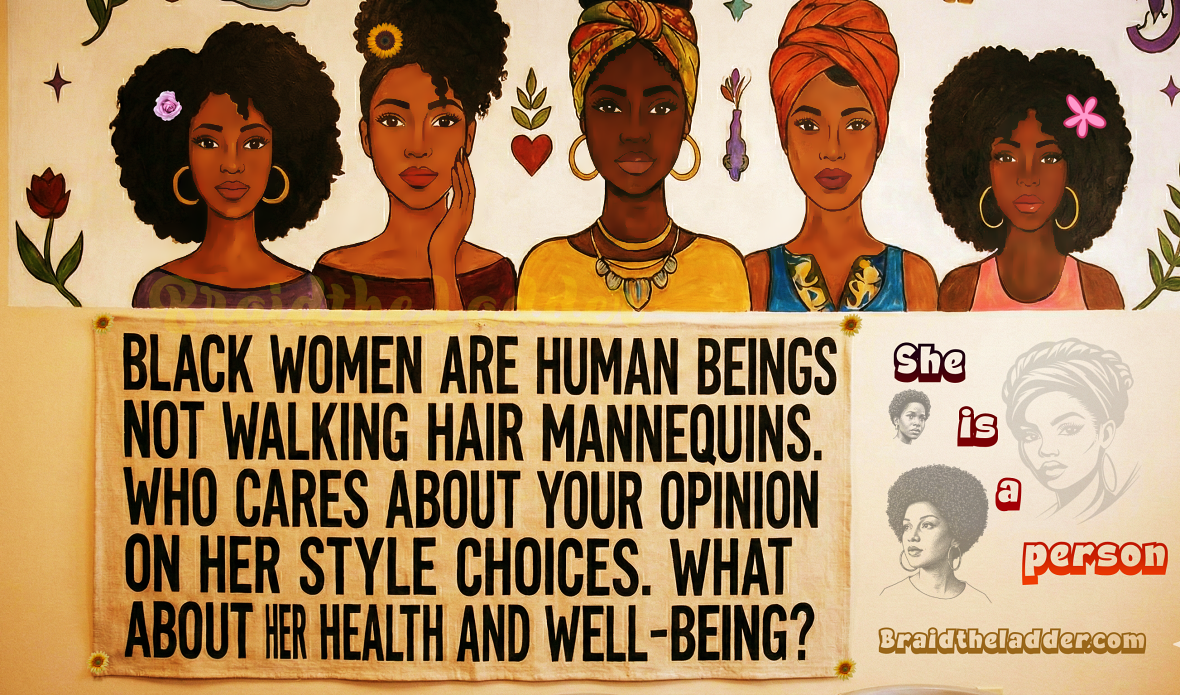
Black Women are Human Beings Not Hair Mannequins
Black women are already fluent in hair.
What too many conversations ignore is what hair is trying to tell us about the body, the nervous system, and the life being lived inside that body.
When strands thin, shed, matt, or refuse to grow, it is often not a “style problem.”
It is a signal.
- Chronic stress can push hair follicles into a resting phase.
- Depression and grief can interrupt cycles of care and nourishment.
- Autoimmune conditions, anemia, thyroid imbalance, and hormonal shifts often show up in hair first.
- Long-term cortisol exposure alters scalp health and texture over time.
In medicine, hair is frequently described as a non-essential tissue—meaning the body will divert nutrients away from it to protect vital organs. That alone tells us something powerful:
When hair changes, the body has already been compensating for a while.
What Black women often receive instead of concern is commentary.
Instead of curiosity, correction.
Instead of care, aesthetic advice disguised as help.
Concern trolling adds load to an already taxed system.
It keeps attention on appearance rather than asking the life-saving question:
How are you actually doing?
A health-centered shift looks different:
- Fewer unsolicited opinions about presentation
- More space to talk about exhaustion, sleep, pain, grief, and overwhelm
- Respect for protective styles as tools, not moral statements
- Recognition that hair care does not replace health care
- An understanding that wellness cannot be styled into existence
Black women do not need to be managed, coached, or corrected about hair.
We need environments that lower stress, reduce surveillance, and support regulation.
Because hair does not exist in isolation.
It lives downstream from safety, rest, nourishment, and peace.
And when those are missing, no amount of tips will fix what the body is trying to survive.
This is not about beauty.
It is about well-being.